Succession planning is the process of ensuring a business continues to operate without the person who built it. It is not a document naming a replacement. It is the transfer of relationships, decisions, and authority to people and systems. That transfer determines whether the business has transferable value or only a job attached to an owner.
Succession is a valuation question before it is a people question
Owners tend to treat succession as a human resources exercise scheduled for later. Buyers treat it as the first diligence question.
An acquirer is not buying revenue. They are buying revenue that continues after the founder leaves. Every relationship, price, and judgment that exists only in one person is a value that does not transfer. That gets priced at a lower multiple, with a larger earnout, or through an employment agreement that keeps the seller in place for years.
The population facing this is not small. The Bureau of Labor Statistics counted 309,400 chief executive jobs in 2024, within a top executive group projected to grow 4 percent through 2034. Ownership transition is a permanent feature of the mid-market, not an event.
The three things that have to be transferred
Relationships. Customers who buy from a person rather than a company. This is the slowest to move and the most damaging to discover late.
Decisions. Pricing authority, credit terms, hiring, and capital spend. Each one still routed to the owner is a bottleneck that a successor cannot inherit because it was never written down.
Institutional judgment. Which jobs to decline, which customers pay, and which supplier substitutions are acceptable. This is the hardest, and the only route is exposing someone else to the decisions early enough to be wrong cheaply.
A worked example, run through a real tool
The company described below is fictional. It was invented for this article and run through two free assessment tools to show what the output looks like. No real client, company, or person is described. The figures are tool output on invented inputs, not market data or benchmarks.
The simulated profile is a precision machining and contract manufacturing business. Revenue between fifteen and thirty million, sixty-one to one hundred fifty staff, more than twenty years in business. The owner is sixty-two and intends to exit within four years.
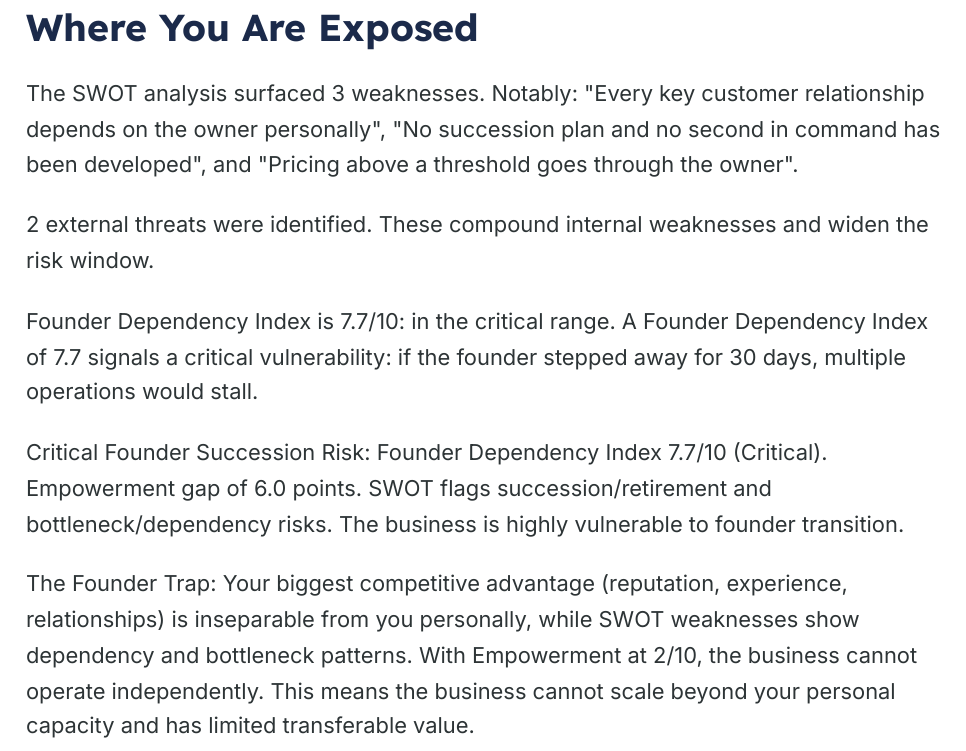
The business is financially healthy. Cash flow, runway, and margin all rated well. The weaknesses entered at the highest confidence were structural rather than financial:
- Every key customer relationship depends on the owner personally
- No succession plan and no second in command have been developed
- Pricing above a threshold goes through the owner
What the assessment returned
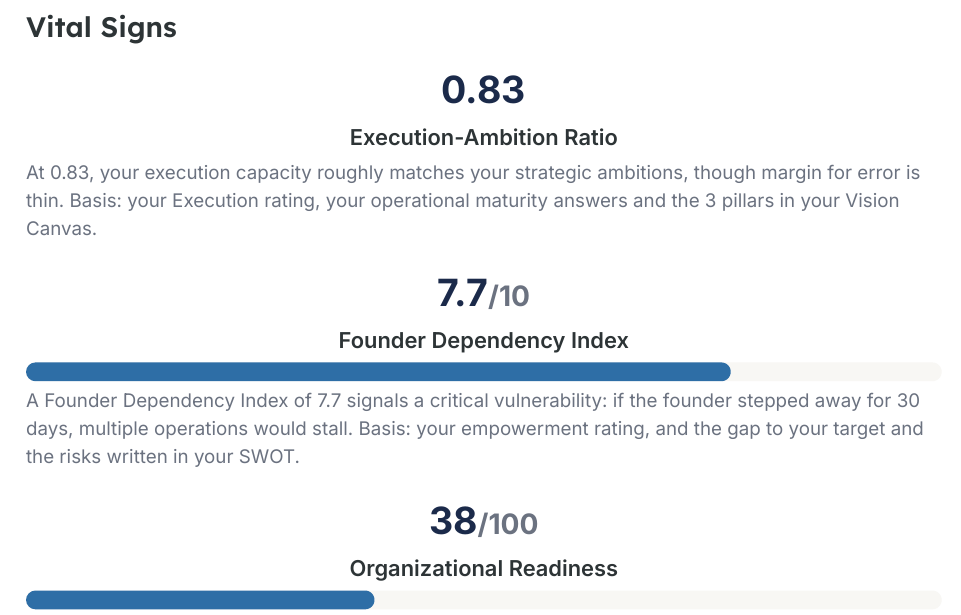
Founder Dependency Index: 7.7 out of 10. The briefing states that this signals a critical vulnerability and that if the founder stepped away for 30 days, multiple operations would stall.
Execution to Ambition Ratio: 0.83. Capacity roughly matches ambition with a thin margin.
Organizational Readiness: 38 out of 100.
The combination is the point. A profitable, certified, thirty-year-old business with strong financials scored in the critical band on dependency. Financial health and transferability are independent; only one of them appears on a P&L.
Why four years is later than it sounds
Four years feels generous and is roughly the minimum for a real transition.
Naming and hiring a general manager takes six to twelve months. Establishing that person with customers takes another year of joint visits before anyone believes the change. Moving the pricing authority requires a full cycle of decisions made and reviewed. Then a buyer wants the arrangement to function for a year before valuing it, because an announced structure is not a proven structure.
That is four years with nothing going wrong. Owners who begin the conversation eighteen months out are usually negotiating an earnout rather than a sale.
Businesses preparing for a transaction should read the financial due diligence alongside this.
Planning an exit inside five years? World Consulting Group builds the transfer sequence before the buyer asks for it. Start with an operating review.
The second-in-command problem
The most common failure is hiring a strong general manager into an unchanged structure.
If pricing still routes to the owner, if customers still call the owner, and if the owner still overrides decisions in the moment, the new manager is an expensive coordinator. Good ones leave within a year, and the owner concludes the market lacks talent.
The order matters. Authority has to move before the person does, or the role exists only on paper. That usually means the owner giving up decisions before feeling ready, and accepting worse decisions for a period as the cost of transferability.
Key person risk in diligence
Diligence surfaces this whether or not the seller raises it. Customer concentration analysis shows to whom the relationships belong. Interviews reveal who makes pricing calls. Absence of documented authority shows up in every process review.
Discovered late, it becomes a price adjustment. Addressed early, it is a structural improvement that raises the multiple. Same fact, different timing, materially different outcome.
What a buyer tests
Buyers do not ask whether a succession plan exists. They test for it indirectly, and the tests are predictable.
They ask who the customer calls when there is a problem, and who signs off on a price concession. They ask what happened the last time the owner took two consecutive weeks away. They listen for whether the answer is a story or a shrug.
They interview the layer below the owner without the owner present. That conversation reveals in twenty minutes whether authority has genuinely moved or has been described as moved.
They examine customer concentration alongside relationship ownership. Concentration is tolerable when the relationship belongs to the company. The same concentration poses a serious risk when it belongs to someone who is leaving.
None of that requires a document. It requires the structure to have existed long enough to leave evidence, which is why the work cannot be compressed into the months before a sale.
The valuation mechanics, plainly
Owner dependency does not usually reduce the headline number. It changes the deal’s structure, which is where the value lies.
A seller with strong financials and high dependency will typically be offered a similar multiple with more of it deferred. Earnout periods lengthen. Employment agreements extend. Escrow rises. Each of those transfers risk back to the seller, and each exists because the buyer cannot be certain the business will perform without the person selling it.
The owner who spends three years moving relationships and authority is not buying a higher multiple so much as buying the right to leave when the transaction closes. For most owners at sixty-two, that is the term that matters more than the number.
Where to start when four years feels short
The first move is not hiring. It is inventory.
List every customer and name who owns the relationship in practice, not on the org chart. List every decision type above a threshold and name who makes it. The output is usually uncomfortable and always clarifying, because it converts a vague worry into a finite list.
The second move is transferring the smallest items first. A mid-sized account, a category of pricing decision, and one supplier relationship. Small transfers create evidence that transfer is possible, which matters more than the individual item.
The third move is the general manager, hired into authority that already exists rather than authority promised. By then, the inventory shows exactly what the role owns on day one.
The sixty-second version
The same situation was typed, in plain language, into a second free tool that returns a written diagnosis rather than scores.
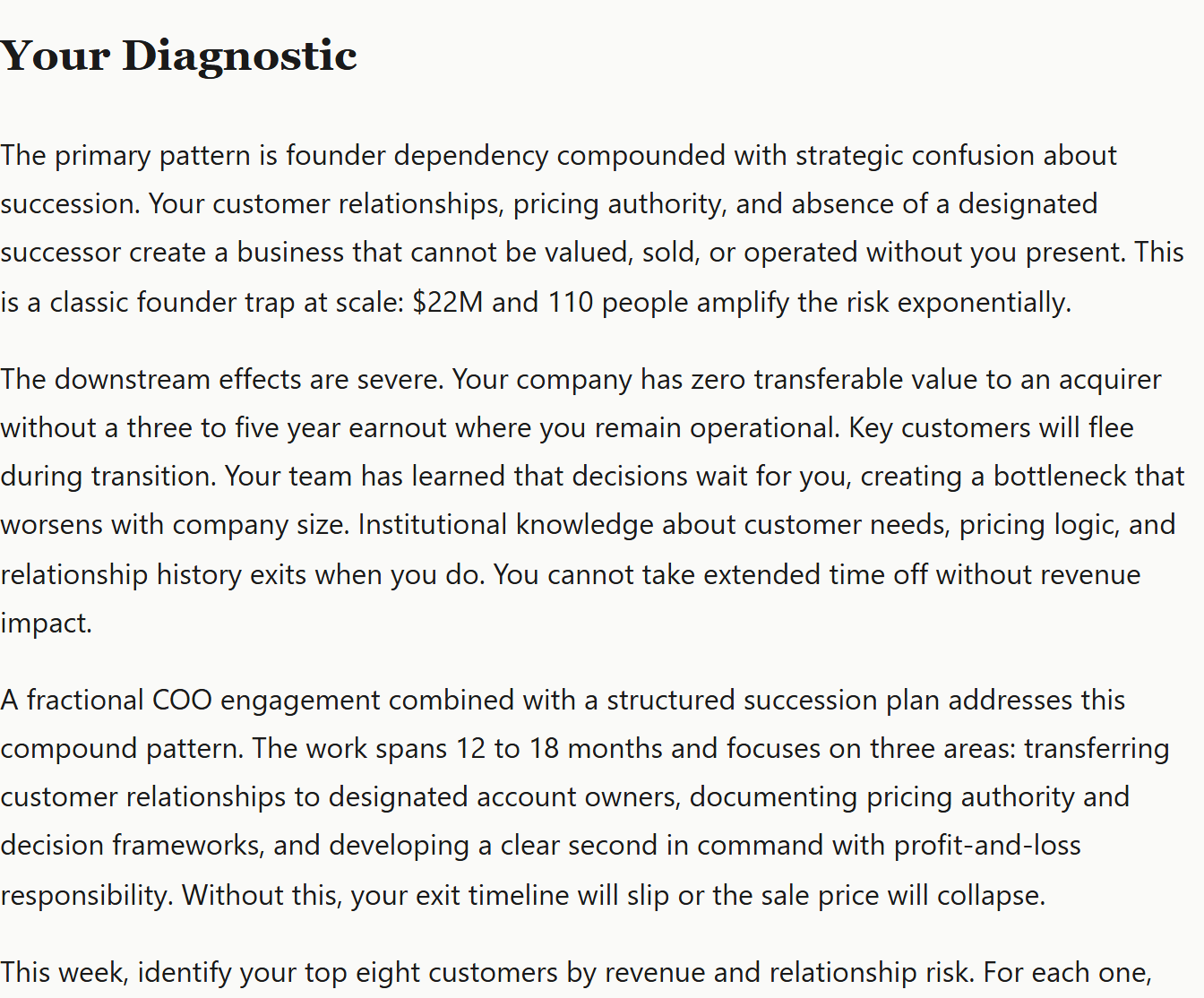
It is named founder dependency compounded with strategic confusion about succession. The conclusion is drawn directly. Customer relationships, pricing authority, and the absence of a designated successor create a business that cannot readily be valued or sold.
That is the sentence most owners do not hear until a buyer says it during diligence.
Where succession work is premature
If the business is not yet profitable or the model is unproven, transferability is not the constraint. Building something worth transferring comes first.
If the owner intends to run the business indefinitely with no transition, the analysis still matters for continuity risk, but the urgency changes. A business that cannot survive thirty days without one person is exposed, regardless of whether anyone plans to sell.
Both tools used here are free. The written one is at businessconsultant.services, and the scored briefing is at vwcg.app. Post-transaction context sits in post-merger integration.
The short version
Succession planning is not naming a successor. It is moving relationships, decisions, and judgment out of one person and into the business, then letting a buyer watch it work.
Financial health does not protect against this. A profitable business that stops when one person leaves is a profitable job, and it is priced as one.
Want to know what would not transfer today? World Consulting Group maps it before diligence does. Book a working session.
Frequently Asked Questions
What is succession planning?
Succession planning is the process of ensuring a business continues to operate without the person who built it. It covers transferring customer relationships, decision authority, and institutional judgment to other people and documented systems, rather than simply naming a replacement in a document.
How long does succession planning take?
Four years is close to the minimum for a full transition. Hiring a general manager takes six to twelve months, and establishing them with customers takes another year. Moving authority takes a full decision cycle. Buyers also want to see the structure functioning before they will value it.
Does succession planning affect business valuation?
Directly. Buyers purchase revenue that continues after the seller leaves. Relationships and decisions held by one person do not transfer. That gets priced at a lower multiple, with a larger earnout, or with a required employment agreement that keeps the seller in place.
What is key person risk?
Key person risk is the exposure that arises when critical relationships, knowledge, or authority rest with a single individual. Diligence surfaces it through customer concentration analysis, interviews, and process review, regardless of whether the seller raises it first.
Why do second-in-command hires fail?
Good ones leave because they are hired into an unchanged structure. If pricing still routes to the owner and customers still call the owner, the new manager coordinates rather than leads. Authority has to move before the person arrives, not after.
Is succession planning only for owners who want to sell?
No. A business that cannot operate for 30 days without a single individual carries a continuity risk regardless of exit intent. Illness, injury, or a sudden departure produces the same exposure that a sale would reveal, without the preparation time.


