A business system is a documented, repeatable way of producing a result that does not depend on who performs it. Firms without them scale to the capacity of their best people and stop. The ceiling is not demand or capital. It is the method for delivering work that exists only inside individuals.
The symptom is turning down work
The recognizable version of this problem is a firm with more demand than it can accept.
Not because capital is short. Because every project depends on a specific senior person, and that week is finite. Adding staff does not help immediately. New people cannot absorb a method that was never written down, so they learn it by observation over many months.
That is the ceiling. Undocumented practice forms that ceiling, and hiring harder does not lift it.
Civil engineering illustrates it well. The Bureau of Labor Statistics counted 368,900 civil engineer jobs in 2024, with 5 percent growth projected through 2034. Technical talent exists. Firms still cap out because the constraint is not the supply of engineers.
What counts as a system
Business systems and processes are not a manual or software. A real system has four parts.
A defined sequence: the steps, in order, with what each produces. A named owner for each step. Entry and exit criteria, so anyone can tell whether a step is finished. And a review point where someone checks the quality before work moves on.
Anything missing those, and it is a preference rather than a system. Most firms have preferences held by senior people, which is why two projects run differently depending on the assignment.
Ramp time is the measurement that exposes it
The clearest instrument is how long a new hire takes to reach target productivity.
Where systems exist, a competent hire reaches the target in three or four months, because the method is available to learn rather than absorb. Where they do not, the same hire takes nine to twelve. They are reverse-engineering practice from whichever senior person they happen to sit near.
Ramp time is also the cost nobody books. Nine months of partial productivity at a professional salary, multiplied across every hire, is usually greater than the total cost of documenting the method.
A worked example, run through a real tool
The company described below is fictional. It was invented for this article and run through two free assessment tools to show what the output looks like. No real client, company, or person is described. The figures are tool output on invented inputs, not market data or benchmarks.
The simulated profile is a civil engineering and land development consultancy. Revenue between three and eight million, sixteen to thirty staff, ten to twenty years in business. Strong technical talent, a growing market, and a stated goal of scaling delivery.
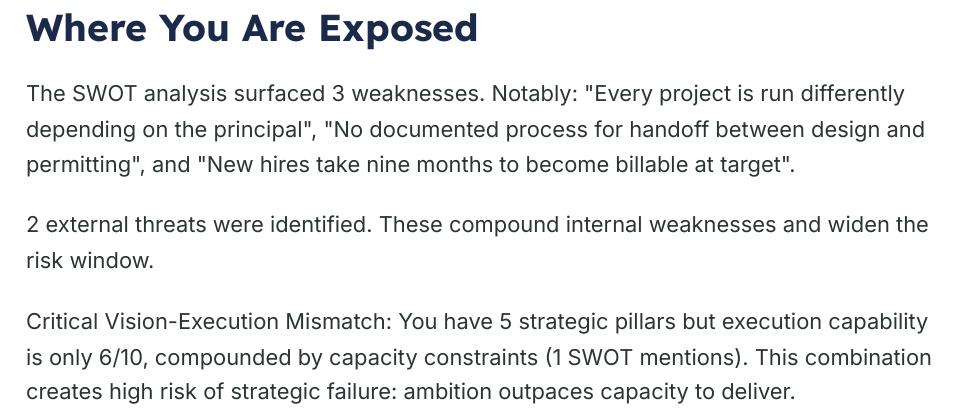
The three weaknesses entered at the highest confidence were:
- Every project is run differently depending on the principal
- No documented process for handoff between design and permitting
- New hires take nine months to become billable at Target
What the assessment returned
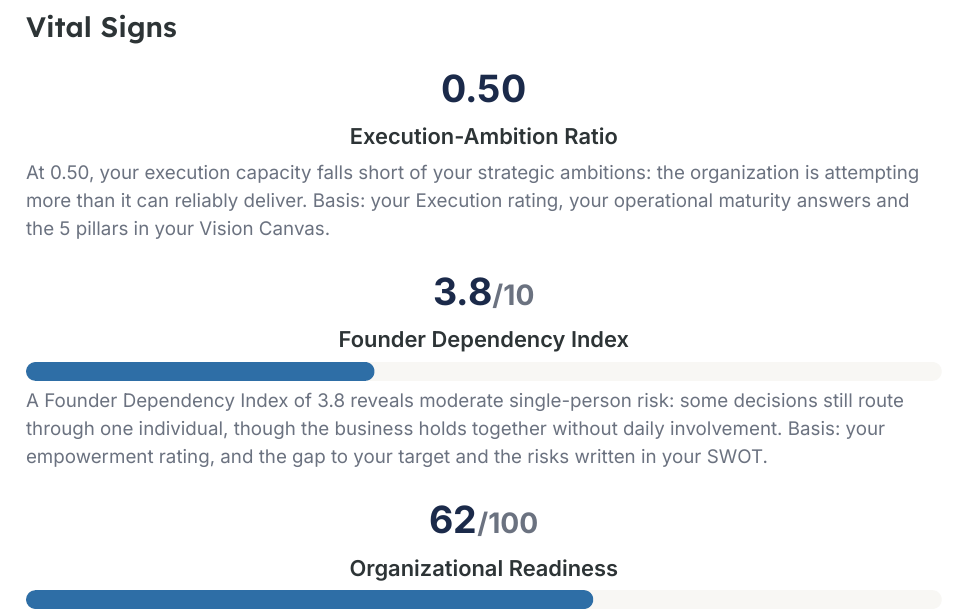
Execution to Ambition Ratio: 0.50. The lowest of any profile run for this series. Execution capacity falls well short of stated ambitions, and the organization is attempting more than it can reliably deliver.
Founder Dependency Index: 3.8 out of 10. Moderate. The business holds together without daily involvement from any single person.
Organizational Readiness: 62 out of 100. The highest of the set.
That combination is unusual and diagnostic. Dependency is low, readiness for change is high, and capacity against ambition is the worst measured. This is not a leadership problem or a resistance problem. The firm is willing and capable, but has no method to scale.
Handoffs are where the work leaks
The weakness worth isolating is the undocumented handoff between design and permitting.
Handoffs are where information is lost, assumptions are re-made, and rework originates. Inside a single discipline, an undocumented process is survivable because one person holds continuity. Across a handoff, nobody does, and the receiving group either asks or guesses.
Documenting the transfer point produces more improvement per hour than documenting either discipline. It is also the least appealing work because it belongs to no one.
Firms working through this at scale should read business process management.
Capping out at your senior people? World Consulting Group documents the delivery method, so capacity stops depending on assignment. Start with an operating review.
Why documentation efforts fail
Most attempts fail the same way. A senior person is asked to write down how they work, produces forty pages, and nobody reads it.
The failure is in the unit. A useful system is written at the level of a decision or a handoff, not at the level of a discipline. One page covering what moves from design to permitting, what must be completed, who checks it, and what happens when it is not will be used. A full delivery manual will not.
The second failure is authorship. Documentation written by whoever has time describes intent. Documentation written by whoever does the work describes practice, which is the only version worth having.
The third failure is treating it as a project. A delivery method documented once and never revised is accurate for about a quarter. Systems need an owner and a review cadence, or they decay into a folder nobody opens.
Quality gates and where review belongs
Firms that lack systems usually do not have a quality review. It happens at the end, performed by the most senior person available, under a deadline.
That is the most expensive possible placement. Errors found at the end have already consumed downstream work, and the person correcting them is the one whose time constrains the firm.
A quality gate placed at a handoff costs a fraction as much. Checking that a design package is complete before permitting it takes minutes. Discovering it was incomplete after permitting has built on it takes days and often a client conversation.
The principle is that review belongs where work changes hands, not where work finishes. Firms usually resist this because early gates feel like bureaucracy, while late review feels like a set of standards.
Utilization visibility as the feedback loop
Without a person’s weekly utilization, a professional services firm cannot tell whether a system’s effort worked.
Utilization is not a productivity whip. It is the instrument that shows whether the documented method moved work off the principles. If utilization on senior staff falls while revenue holds, the system is working. If revenue rises while senior utilization stays pinned, the firm has grown without changing its ceiling.
That measure also catches the failure mode in which documentation exists, but nobody uses it. Method adoption is invisible in a document review and obvious in the distribution of hours.
What the first ninety days should produce
The realistic first-quarter target is one documented handoff, adopted.
Choose the handoff that generates the most rework, which the delivery team can name without analysis. Have the two groups on either side of it write the transfer definition together in a single session. Define what has to be completed, in what form, checked by whom, and what happens when it is not.
Then use it on every project for a quarter and revise it twice. Adoption comes from use and correction, not from launch.
One adopted handoff beats a complete manual, because it proves the method works and gives the firm a template it wrote itself. Firms that attempt full documentation first usually produce nothing usable and conclude that systems are not suited to professional work.
The sixty-second version
The same situation was typed, in plain language, into a second free tool that returns a written diagnosis rather than scores.
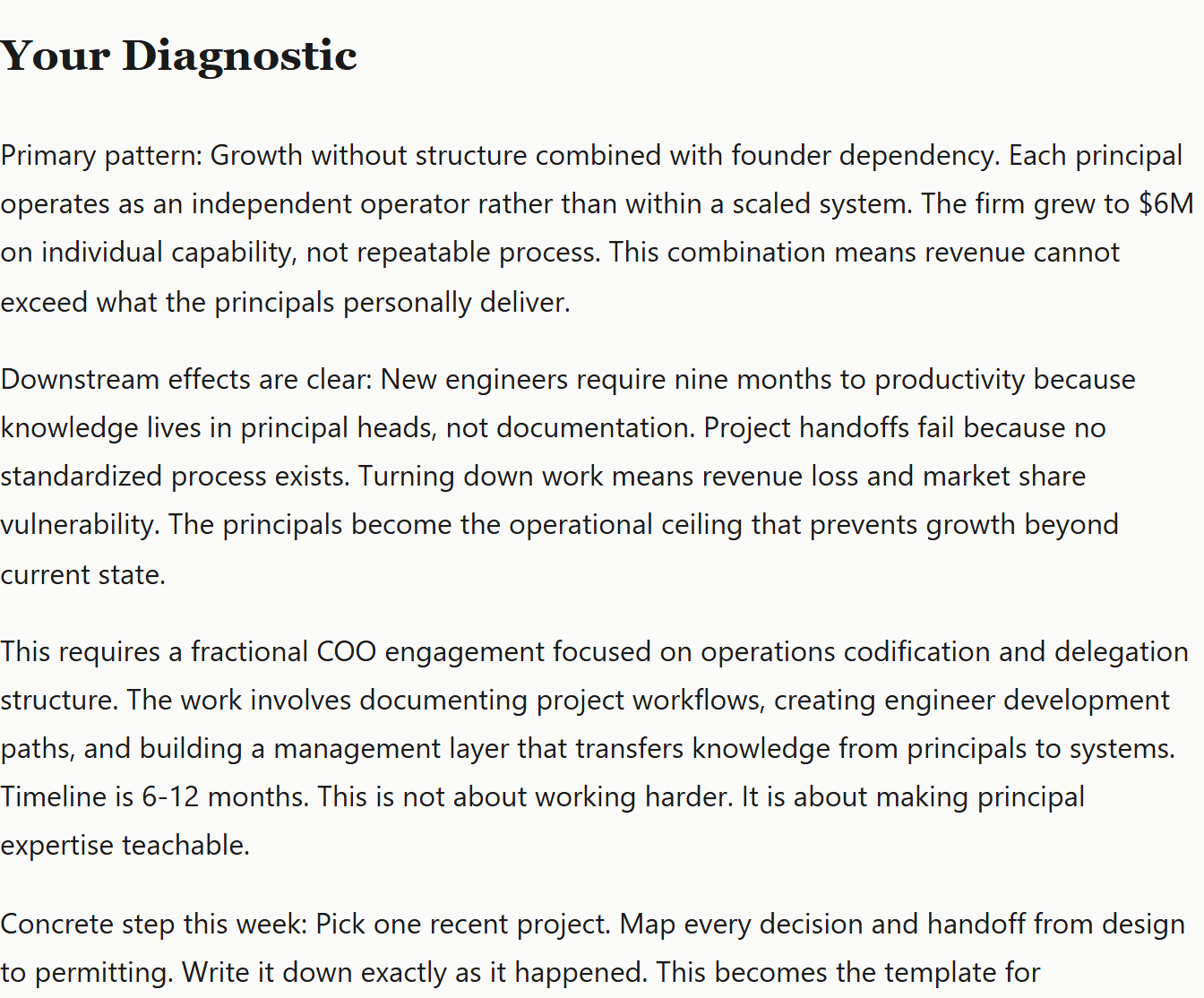
It is named growth without structure, combined with founder dependency. The mechanism is identified precisely. Each principal operates as an independent operator rather than within a scaled system, and the firm grew on individual capability rather than a repeatable process.
Where systems work is the wrong priority
If the firm is not winning enough work, documentation will not create demand. The tell is an idle senior capacity rather than a queue.
If the work is genuinely bespoke, meaning every engagement is materially different, forcing a uniform process destroys the value clients pay for. That case is rarer than firms believe and is often confused with the far more common situation in which delivery varies by preference rather than by client need.
A structured diagnostic separates the two before money is committed. Both tools used here are free. The written one is at businessconsultant.services, and the scored briefing is at vwcg.app. Broader framing sits in business transformation consulting.
The short version
Business systems determine whether capacity belongs to the firm or to individuals. Firms without them grow to the limits of their best people and then trade away opportunities.
Start with a handoff rather than a discipline. Have the work done by the person who does it. Measure success by ramp time, because that number moves before revenue does.
Not sure whether the constraint is demand or delivery? World Consulting Group identifies which before recommending a fix. Book a working session.
Frequently Asked Questions
What are business systems?
A business system is a documented, repeatable way of producing a result that does not depend on who performs it. It requires a defined sequence, a named owner for each step, entry and exit criteria, and a quality review point before work proceeds.
How do you know if a firm lacks systems?
The clearest indicator is ramp time. Where systems exist, a competent hire reaches target productivity in three to four months. Where they do not, the same hire takes nine to twelve months because practice must be absorbed by observation rather than learned.
Why do documentation projects fail?
Two reasons. The unit is wrong, producing long manuals nobody reads instead of one-page handoff definitions people use. And authorship is wrong, written by whoever has time rather than whoever does the work, so it describes intent instead of practice.
Where should systems documentation start?
At a handoff between groups rather than within a discipline. Handoffs are where information is lost and rework originates, because no individual holds continuity across them. Documenting a transfer point produces more improvement per hour than documenting either side.
Do business systems reduce quality in professional services?
Not when written at the level of sequence and review rather than technical judgment. Systems define what must be complete and who checks it. The professional decision inside each step remains with the professional making it.
When is systems work the wrong priority?
When the firm is not winning enough work, indicated by idle senior capacity rather than a queue. Documentation does not create demand. It only converts existing demand into deliverable capacity that no longer depends on specific people.


